A Landscape of Loss after the Disintegration of Uniformity — Kang Jaegu’s Privates and Reservists
This magazine introduces a young artist recommended each month by an exhibition curator or critic. As part of a series introducing emerging artists who show the potential to become significant figures in the Korean photography scene, the tenth artist featured is Kang Jaegu, recommended by Kim Min-sung, director of Style Cube Zandari.
(Editor’s Note)
Written by Kim Min-sung (Director of Style Cube Zandari | mskim@zandari.com)
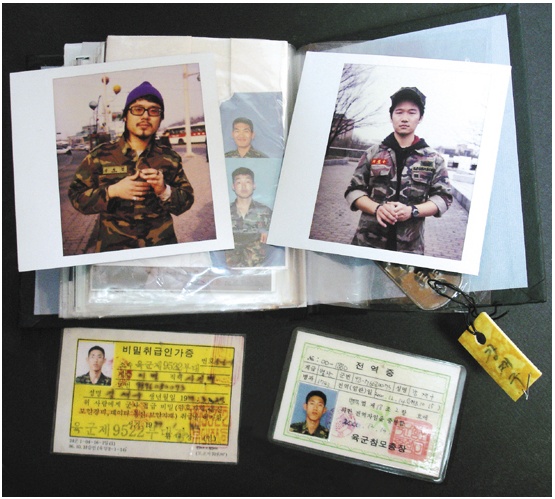
Primary Materials from the Early Stage of the Project
The military. A place where the remnants of fascism still linger through collective uniformity and an exclusive organizational system. Yet even there, people live, and they are called soldiers. Under the peculiar attention surrounding South Korea as the only divided nation in the world, Korean soldiers continue to maintain the justification of their existence. The models appearing in Kang Jaegu's Private Soldiers and Reservists series are precisely those who are, or once were, soldiers. Within this particular collective, where the whole is prioritized over the individual and where authority is formed through physical force, they learn uniformity in order to sustain the identity of the group. From their hairstyles to even a single piece of underwear, personal preferences are absolutely not permitted. Such a system would be impossible in an autonomous realm where diversity is celebrated and individualistic aesthetics are recognized. Uniformity is an important justification and means of maintaining existence within the military. Generally, privates at the beginning of their military service lose their self-centered world through this process of uniformity. However, Kang Jaegu radically transforms the fate of the private soldier. By having privates, who represent a lost center of existence, remove their military uniforms, he attempts a primary dismantling of uniformity. The military uniform has the power to visually standardize individuals who possess completely different social relationships and personal backgrounds. By dismantling not only the coercive force of the uniform but also the collective power it represents, Kang shifts the focus away from the military rank of "private soldier" and toward the human figure itself. Perhaps, as the artist himself suggests, this may be a process of giving even a small amount of life back to the private soldiers who are considered almost equivalent to the dead. Here, the private soldier may be the only living presence within the military, a place that remains a kind of simulacrum for those who have never experienced military service. If Kang Jaegu's Private Soldiers represents the restoration of a lost center through the dismantling of uniformity, his Reservists can be understood as subjects living in a reflective state, still embracing the lingering traces of military life. The lost center within the enormous simulated space of the military returns to society, where it experiences a period of reflection and dislocation. In other words, reservists embrace a longing for uniformity while existing in a state of social maladjustment after returning to civilian life. For reservists, conversations about military experiences during drinking gatherings become something beyond simple memories. It is an irony.
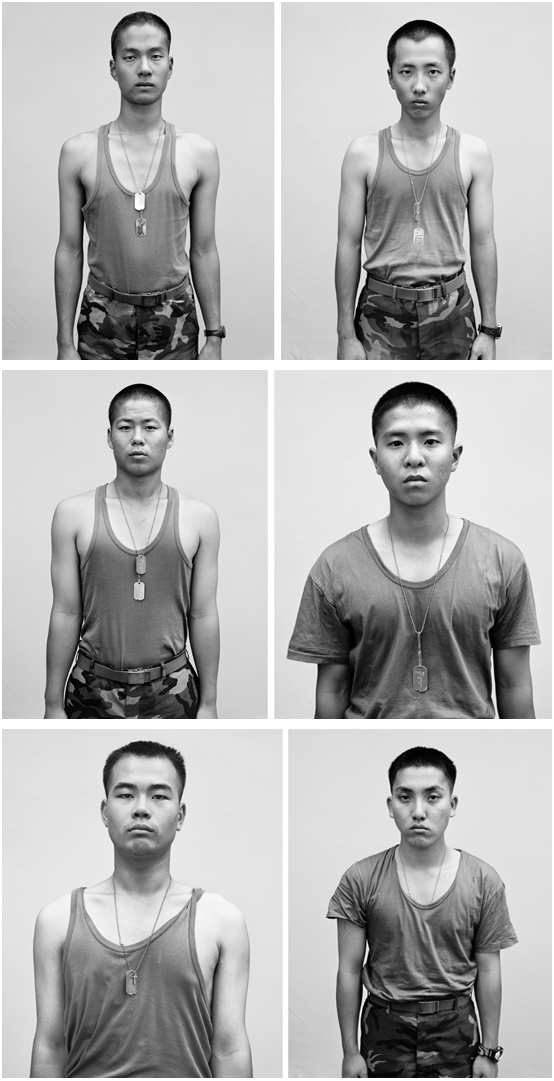
Private Soldier, gelatin silver print, 2003
In this sense, the figures appearing in Kang Jaegu’s Private Soldiers and Reservists series are reflections on the contradictory duality of contemporary individuals. Furthermore, because these subjects evoke the effect of authenticity, which is considered fundamental to the nature of photography, they may further strengthen the artist’s contemplation.
However, hidden within this work is a kind of military booby trap unconsciously constructed by the artist. It is a peculiar challenge to the essence of photography, which has traditionally been represented through authenticity.
At a certain moment, Kang Jaegu’s Private Soldiers and Reservists become another signifier of the dual nature of the medium of photography itself, a medium that now exists at the center of the viewers’ fascination and enthusiasm.
In contemporary society, where the loss and recovery of a center coexist with the irony of remembering that process, the private soldier and the reservist can be understood, in a broad sense, as our own self-portraits. In a narrower sense, they represent the self-portrait of photography itself.
Although seeking the identity of photography through the human figures depicted within photographs may appear contradictory, perhaps there is no better way to discover the true nature of photography than through this very contradiction.
Then, what is the image of photography today that Kang Jaegu’s figures are speaking of?
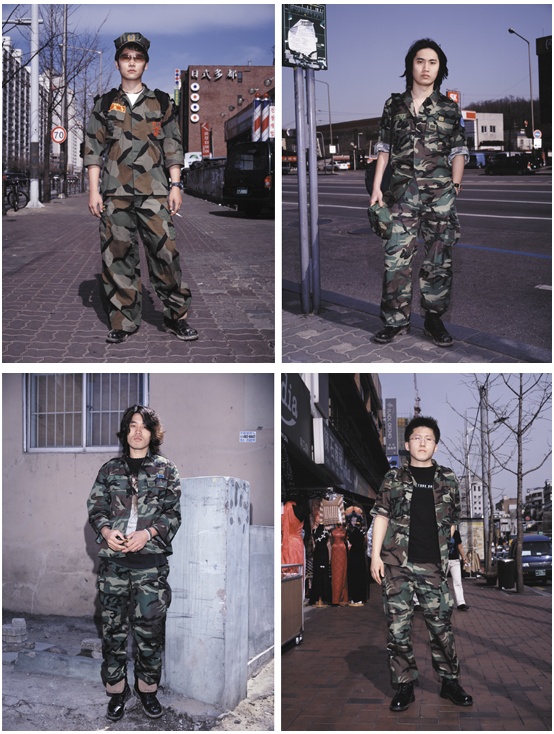
Reservist, Chromogenic Print, 2004
Within a relatively short period of time, photography severed its umbilical cord from modernism and passed through the environment of postmodernism, adopting a quantum-like attitude amid countless discourses. In fact, since the emergence of postmodernism, contemporary art has developed through two representative positions: the modernist and the non-modernist. The confrontation between these two positions has led to the emergence of diverse media within the art world. Viewers who once celebrated the mainstream of abstraction gradually became accustomed to new forms of art through the experience of becoming not only the recipients of artworks but also active participants and subjects of appreciation. Meanwhile, artists have moved away from self-centered exploratory attitudes and have begun to position themselves within social contexts, exploring the structures through which meaning is constructed. From the perspective of modernism, which has been deeply rooted in abstraction and aestheticism, the acts of repetition, reproduction, and spatial occupation that dominate contemporary art today may have appeared as challenges to the artistic values preserved throughout a thousand years of history. However, genres such as photography, video, and installation, which have expanded and transformed through postmodernism, have gathered together and planted their flags at the summit of contemporary art. And at the very center of this transformation is photography. Above all, photography delivered a decisive blow to the long-established artistic value of uniqueness. As a result, the loss of the center within art emerged once again. Although the so-called dialectical process of thesis, antithesis, and synthesis is said to have disappeared after postmodernism, it in fact still exists. It exists, for example, in Kang Jaegu’s Private Soldiers and Reservists, which continues to exist within contemporary Korea. And it exists in the fictional constructive power of photography itself, a medium that appears as though it speaks of reality.
Kang Jaegu’s perspective may appear somewhat ambiguous, yet it is remarkably precise. Although he seems to successfully overcome the uniformity of the military that caused the symbolic death of the private soldier by removing the uniform, the military dog tag — a signifier of the military itself — still remains hanging around the private soldier’s neck. Along with the dog tag, the unmistakable presence of the private soldier’s hair, which cannot be completely removed, allows even those who have never experienced military service to immediately recognize them as soldiers. The dissonant clothing of the reservists likewise conveys to the public an unconscious sense of identification with the uniformity of the military. Through these processes and images, Kang Jaegu creates a landscape of uniformity that cannot disappear from contemporary society or from the world of art. Even after being dismantled, uniformity has not been completely eradicated. Instead, it continues to barely sustain contemporary society, revealing itself as a gray dilemma of our time. It is something that cannot be entirely escaped, no matter how much contemporary society’s systems of education, politics, and art struggle to move beyond uniformity. Although uniformity appears to have been dismantled, the persistent movement of a lost center remains an unavoidable landscape of our present condition.Therefore, Kang Jaegu’s Private Soldiers and Reservists represent a landscape of loss after the disintegration of uniformity.